

Ikigai — Your Reason for Being
Ikigai (ee-kee-guy) is a Japanese word that means "a reason for being" — the reason you get up in the morning. It comes from Okinawa, Japan, home to some of the longest-lived people on earth, where having a clear purpose is simply a way of life.
Your ikigai is found where four things meet: what you love; what you are good at; what the world needs; and what you can be paid for. Where two of them overlap, you find your passion, your mission, your profession, or your vocation. Where all four meet, you find your ikigai — a life that gives you energy instead of draining it.
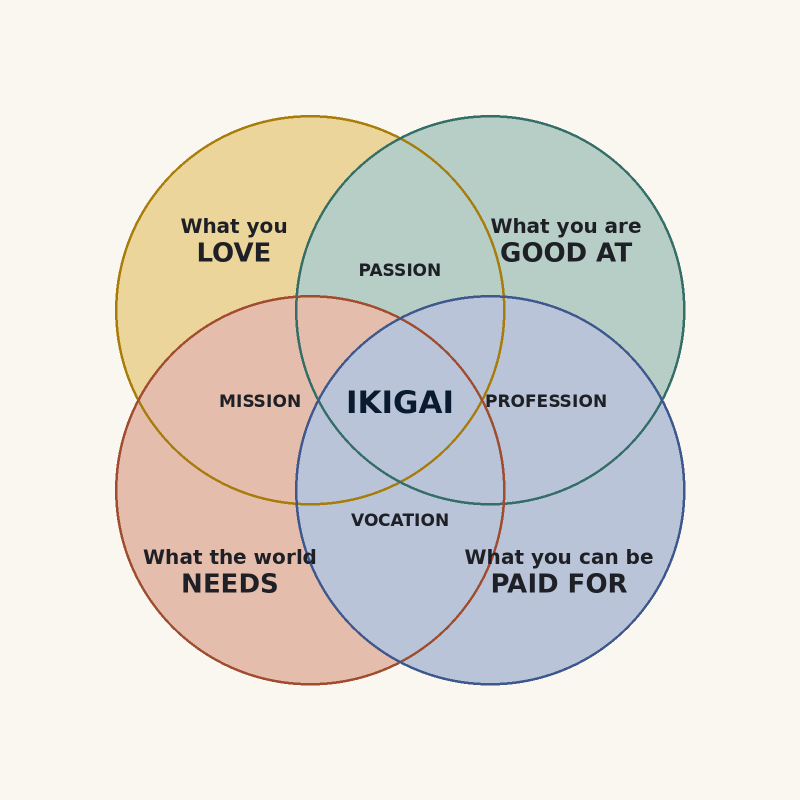
The Ikigai diagram — your reason for being lives at the center, where all four circles meet.
Ikigai and 360 Degrees to Total Health
Ikigai is the purpose at the heart of the 360 Degrees framework. In 360 Degrees to Total Health, Ricardo Simone shows how a balanced life is built on four connected areas — physical, mental, spiritual, and financial. Ikigai ties them together: it is the anchor that gives the other three direction. When you know your why, you take care of your body, you guard your mind, and you steward your money with intention.
Go deeper in the book: 360 Degrees to Total Health, available now on Amazon — https://www.amazon.com/dp/B0HQVLDLGM
The Ikigai Test — Find Your Center
Take five quiet minutes. Think of the activity or work you are drawn to most, and score each statement from 1 (not true of me) to 5 (completely true of me). Add up each group of three.
WHAT YOU LOVE — 1. I lose track of time when I am doing this. 2. I would do this even if nobody paid me. 3. I feel energized, not drained, when I finish.
WHAT YOU ARE GOOD AT — 4. People come to me for help with this. 5. I do this better than most people I know. 6. I have spent years practicing and improving at this.
WHAT THE WORLD NEEDS — 7. This helps people or solves a real problem. 8. People thank me and tell me it made a difference. 9. My community would miss this if I stopped.
WHAT YOU CAN BE PAID FOR — 10. People already pay for this, or they would. 11. There is a job, a business, or a service built on this. 12. I can name who would pay, and why.
HOW TO READ YOUR RESULTS: Look for the activity that scores high in all four groups — that is where your ikigai lives. If one group scores much lower than the others, that is your growth edge. A passion with no income is a hobby. A skill nobody needs is unused potential. Work you can be paid for but do not love is a job, not a calling.
YOUR IKIGAI STATEMENT: Now write one sentence: "My ikigai is to ___ (what you do) for ___ (who it serves), because ___ (why it matters)." Keep it where you will see it every morning.